Day 12 – A Love Letter to Documentation (and Sanity)
Dec. 11, 2024, 9:12 p.m.
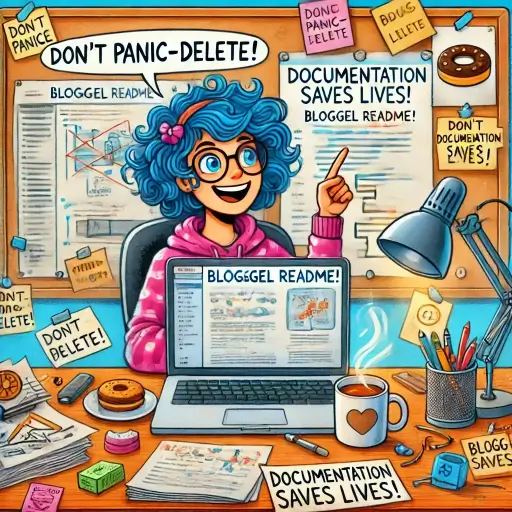
Greetings, fellow coders, curious minds, and accidental visitors who likely mistyped “Google” as “Blogggel.” Pull up a chair; let me regale you with tales of triumph and mild existential crises as I recount Day 12 of my capstone development journey. Spoiler alert: It involves documentation. Lots and lots of documentation.
Let’s begin with a confession:
I didn’t always see the value of documenting my code. “It’s fine,” I used to think. “Future Me will understand exactly what Past Me was doing.” Reader, Future Me rarely does. Today, however, was all about proving that even a developer with a penchant for overthinking (hello) can produce a README worthy of being framed and hung in a museum—or at least bookmarked.
The Quest for the Perfect README
Armed with caffeine and a keyboard, I set out to turn my GitHub README into a riveting narrative—part instruction manual, part diary, and part manifesto. Blogggel, my humble blogging platform, deserved a proper story, and I was determined to tell it. Here’s what I tackled:
1. The Introduction:
I wanted anyone stumbling upon Blogggel’s repo to immediately feel the drama, the stakes, and the glory of its creation. "This project began as an ambitious recipe app featuring AI and OCR," I wrote, "and ended as a blogging platform that actually works."
It’s important to set the tone early, and mine was somewhere between “upbeat perseverance” and “please clap.”
2. Features:
I listed Blogggel’s features with the kind of enthusiasm one might reserve for describing a revolutionary invention.
- View blog posts!
- Create blog posts!
- Update blog posts!
- Delete blog posts!
Groundbreaking? Perhaps not. Functional and well-documented? Absolutely. The “Delete” functionality even comes with a confirmation prompt, because I’ve learned my lesson about accidentally deleting things (looking at you, Original Recipe Repo).
3. Wireframes:
Remember the sketches I hastily drew up back on Day 6? They’ve now been immortalized in my README, complete with captions like, “Yes, this is supposed to be a button.” They’re rough but charming, much like the first version of Blogggel itself.
4. Installation Instructions:
If there’s one thing I’ve learned, it’s that a good README answers the age-old question, “But how do I make this work on my laptop?” I painstakingly outlined every step: cloning the repo, running the app locally, and deploying to Heroku—all written in a tone that says, “You’ve got this,” but also, “Please don’t skip steps.”
5. Known Issues:
Every project has its quirks, and Blogggel is no exception. I listed a few bugs, like the time the form validation went on strike and refused to give useful error messages. Rest assured, these are scheduled for fixing… right after I’ve had a biscuit.
6. Lessons Learned:
Ah, the pièce de résistance. I waxed poetic about the lessons Blogggel has taught me: the perils of over-ambition, the value of starting small, and the absolute necessity of version control (and triple-checking before hitting delete). I even threw in a motivational quote for good measure: “Programming is like writing a novel, except your characters never do what you tell them to.”
The Emotional Rollercoaster of Writing It All Down
As I wrote, I couldn’t help but marvel at how far I’ve come since Day 4, when I sat staring at a blank repo after my catastrophic panic-delete incident. Back then, it felt like the end of the world; now, it’s a funny anecdote I can drop into job interviews to show resilience.
Documenting this journey has been cathartic. It’s reminded me that every misstep and every victory has shaped Blogggel into what it is today: a simple, functional, occasionally humorous blog platform that I’m incredibly proud of.
Final Thoughts
Today’s takeaway? Don’t underestimate the power of a good README. It’s not just for others; it’s for you. It’s a time capsule of your journey, a map for navigating your code, and a monument to your hard work.
Now, if you’ll excuse me, I’m off to celebrate this milestone with a nice cuppa and a digestive biscuit. Blogggel awaits its next adventure, and so do I.
Yours in code and caffeine,
Sazzzel
Comments (0):
No comments yet. Be the first to comment!